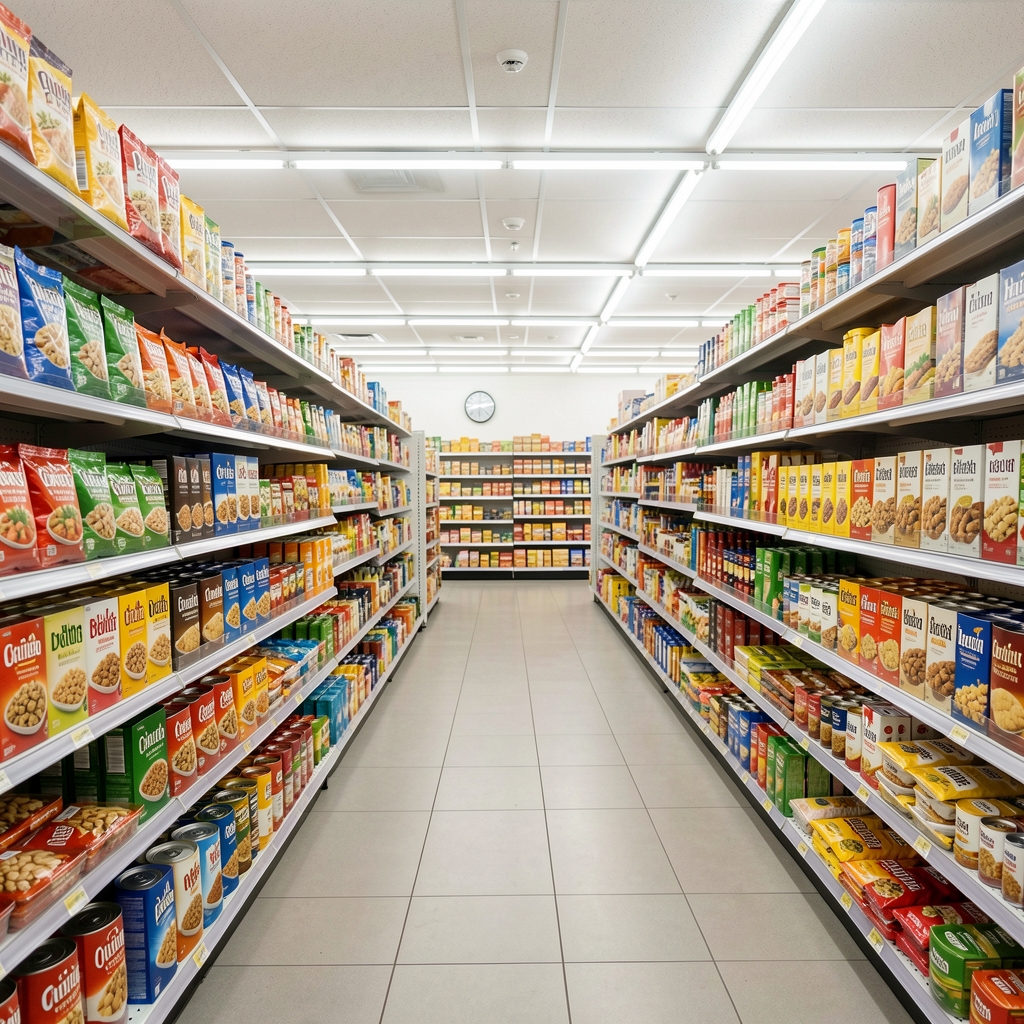
In the weekly rhythm of the average English household, the distance between purchasing a ready meal and sitting down to eat it has compressed to a matter of minutes. That compression carries a measurable nutritional cost — one that extends well beyond simple calorie arithmetic into the structure of appetite signalling, satiety timing, and long-term weight regulation.
What Processed Food Reliance Actually Means
The term "processed food" covers a wide spectrum — from minimally processed items like rolled oats and tinned tomatoes to ultra-processed products engineered for palatability: soft drinks, reconstituted meat products, flavoured crisps, and pre-assembled pasta sauces loaded with stabilisers and sweeteners. The distinction matters because the nutritional consequences differ substantially across that range.
Ultra-processed foods are characterised by their high energy density per gram, their low fibre content, and their formulation to minimise the time required for the digestive system to register satiety. Research published in peer-reviewed nutritional journals consistently identifies ultra-processed food consumption as a significant contributor to excess caloric intake — not primarily because individuals choose to overeat, but because the physiological feedback mechanisms that ordinarily regulate appetite operate on a slower timescale than the speed at which ultra-processed foods can be consumed and absorbed.
Ready meal reliance in England has grown incrementally over several decades. Survey data from nutritional epidemiology studies suggest that households purchasing five or more ready meals per week consume measurably higher quantities of sodium, refined carbohydrates, and saturated fat than households preparing the majority of meals from raw or minimally processed ingredients — even when overall caloric targets appear comparable.
Hidden Sugars: The Labelling Gap
One of the more technically precise challenges in assessing everyday food intake involves the identification of added sugars across product categories not conventionally understood as sweet. Pasta sauces, savoury crackers, coleslaw, and certain breads regularly contain measurable quantities of added glucose syrup, fructose, or maltodextrin — none of which appear prominently on front-of-pack nutrition summaries.
Liquid calories represent a parallel challenge. Sweetened coffee drinks, flavoured waters, fruit juice blends, and carbonated beverages contribute to total daily sugar intake in a way that nutritional recall surveys systematically under-capture — because individuals do not categorise liquid consumption with the same dietary attention they apply to solid food. The practical implication is that a household tracking food intake may accurately log their meals while substantially underestimating their total sugar exposure by 40–80 grams daily.
From a weight accumulation standpoint, the mechanism is not simply caloric. Rapid glucose delivery from refined carbohydrate sources and added sugars produces insulin response patterns that, over repeated daily cycles, can shift the body's fat-storage signalling in ways that persist beyond individual meal events.
"The issue is rarely appetite in the simple sense. It is the structural mismatch between how quickly convenience foods deliver energy and how slowly the body registers that delivery."
Eleanor Whitfield, Kareno Dispatch
Portion Distortion and Packaging Design
The concept of portion distortion refers to the progressive recalibration of what constitutes a standard serving size — a recalibration driven in significant part by the incremental expansion of packaging formats. A single-serve crisp packet in England today contains roughly 60% more product by weight than comparable formats from two decades ago. Multi-serve ready meal trays are routinely consumed as single portions, despite carrying nutritional information predicated on a two-person sharing assumption.
Portion distortion is not a failure of individual judgement. It reflects the absence of reliable external reference points in an environment where portion norms are set by commercial packaging decisions rather than nutritional standards. When the container is the portion guide — as it effectively is for most convenience food categories — the container's size becomes the primary determinant of consumption volume.
Eating speed compounds this dynamic. Consumption rate is a documented factor in satiety signalling — the faster food is eaten, the less time the digestive system has to produce the physiological signals that communicate fullness to the brain. Ultra-processed foods, by virtue of their low mechanical resistance (they require minimal chewing), are consumed significantly faster than whole-food equivalents. An independently verified 2022 nutritional analysis found a mean consumption rate differential of approximately 35% between matched ultra-processed and whole-food meal conditions.
High-Salt Habits and Their Secondary Effects
Sodium content in processed and convenience food categories in England consistently exceeds recommended daily intake thresholds when consumption patterns are assessed across a full seven-day recall. The direct cardiovascular implications fall outside this publication's editorial scope. The relevance to weight accumulation lies in secondary effects: elevated sodium intake is associated with increased fluid retention, which contributes to measured body weight in ways that can obscure underlying fat mass changes and make self-monitored weight tracking less interpretively reliable.
High-salt food consumption also correlates with increased fluid intake from sweetened beverage sources — a behavioural pattern with its own caloric contribution. The substitution of plain water for sweetened drinks in high-sodium dietary contexts represents one of the more straightforward adjustments available to individuals seeking to reduce incidental caloric intake without restructuring their overall eating pattern.
- 01 Ultra-processed foods are formulated to be consumed faster than whole-food equivalents, shortcircuiting satiety signalling.
- 02 Liquid calories from sweetened beverages are systematically underestimated in nutritional recall assessments.
- 03 Portion norms are largely set by commercial packaging dimensions, not nutritional standards.
- 04 Elevated sodium intake from ready meals can mask underlying compositional changes in self-monitored weight tracking.
Gradual Dietary Adjustment as an Analytical Framework
The evidence base for abrupt dietary overhaul as a sustainable weight management strategy is, to put it precisely, modest. Longitudinal nutritional studies consistently show that gradual dietary improvement — defined as incremental substitution of ultra-processed items with less processed alternatives over a period of weeks or months — produces more durable outcomes than rapid structural change, primarily because gradual substitution requires less cognitive load and produces fewer compensatory behaviours.
The practical translation is straightforward: identifying two or three processed food categories with the highest habitual consumption frequency, and introducing lower-processing alternatives at a pace that does not disrupt the household's existing meal preparation infrastructure. Cooking at home benefits extend beyond nutritional composition — they include portion control, ingredient visibility, and the pace at which food is prepared and eaten.
Kareno Dispatch's editorial approach to this subject is descriptive rather than prescriptive. The patterns outlined in this article are drawn from published nutritional research and observational dietary studies. Readers with specific concerns about their daily routines are encouraged to speak with a qualified wellness professional.