In dietary recall studies, the period between 21:00 and midnight is consistently under-reported relative to its actual caloric contribution. This is not exclusively a documentation failure — it reflects a genuine characteristic of late-night eating: it operates in a context of reduced attentional engagement, where conventional appetite monitoring is at its least active. That context is precisely what makes mindless snacking a structurally distinct challenge from other unhealthy eating habits.
Defining Mindless Snacking
Mindless snacking refers specifically to food consumption that occurs as a secondary activity — where the primary activity is something else entirely (watching television, scrolling a phone, working on a screen). The eating is not the focus; it is incidental. This distinction matters because it separates mindless snacking from deliberate snacking, which is a conscious, often portion-controlled eating event.
The practical distinction in terms of caloric outcome is substantial. Deliberately consuming a portion of biscuits — opening a packet, taking a defined amount, and eating it — produces measurably different caloric outcomes than consuming biscuits while watching a programme, because the latter involves no defined termination point. Research on attentional eating consistently finds that divided-attention eating results in consumption 25–40% higher than focused eating of the same food category.
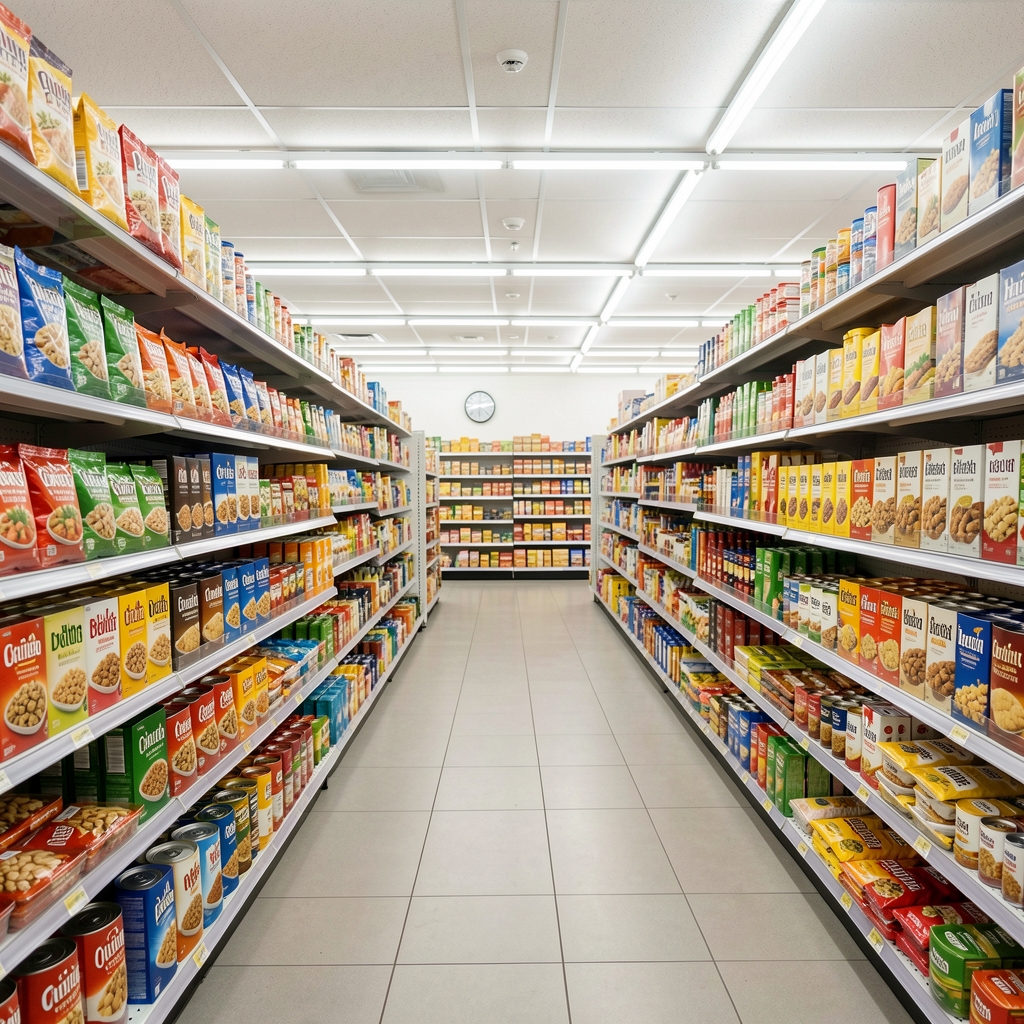
Convenience food patterns are particularly prevalent in the late-evening snacking context. The foods most commonly consumed during late-night eating periods — crisps, biscuits, chocolate bars, flavoured nuts — share characteristics that make them particularly suited to secondary-activity consumption: they require no preparation, minimal attention to eat, and are packaged in quantities exceeding a single-sitting serving.
Liquid Calories in the Evening Hours
Liquid calories awareness is particularly relevant in the evening eating context. Post-dinner beverage consumption — including alcohol, sweetened hot drinks, flavoured sparkling water, and fruit juice — is rarely incorporated into informal dietary self-monitoring because liquids are not categorised as food in the ordinary cognitive framework most individuals apply to their eating.
Alcohol is the most calorically significant of these in terms of frequency of consumption. A standard 250ml glass of medium-bodied red wine contributes approximately 190–210 kcal. Two glasses — a common evening consumption quantity among working-age adults in England — adds roughly 400 kcal to the day's intake without any subjective sense of having "eaten" anything. When combined with the disinhibitory effect of alcohol on subsequent food consumption — a well-documented phenomenon in nutritional research — the total late-evening caloric contribution frequently exceeds that of a structured meal.
Sweetened hot beverages present a related but distinct challenge. A prepared hot chocolate drink made with full-fat milk and a standard sachet of drinking chocolate powder contributes 250–310 kcal, while being categorised cognitively as a "drink" rather than a caloric event. The same pattern applies to speciality coffee drinks consumed at home using capsule machines and flavoured syrups.
"The evening hours represent a structural gap in dietary self-monitoring — not because individuals intend to eat more, but because the attentional context in which that eating occurs actively suppresses the tracking mechanisms that function during the day."
Eleanor Whitfield, Kareno Dispatch
Late-Night Eating and Fat Storage Efficiency
Beyond the caloric quantity of late-night eating, the timing of consumption relative to sleep has received increasing attention in nutritional research. The body's energy processing systems are not uniformly active across the 24-hour cycle — they operate on a schedule that prioritises energy utilisation during the active phase and shifts toward storage during the rest phase.
The practical implication is that equivalent caloric amounts consumed at different points in the day may have different metabolic outcomes. Research on circadian nutrition has documented that caloric intake in the two to three hours before sleep produces different appetite-signalling patterns the following morning compared to the same intake consumed earlier in the day — specifically, lower perceived hunger in the morning, which is associated with delayed breakfast consumption and the meal-skipping cycle described in the previous article in this series.
This is a technically complex area of nutritional research, and the Kareno Dispatch editorial standard requires acknowledging the limitations of available evidence. The circadian nutrition field involves several competing models, and individual variation in circadian rhythm structure is substantial. What the evidence does consistently support is the observation that late-night eating tends to produce compressed eating-window effects — where the body has less active time to process and utilise consumed energy before the rest phase begins.
The Role of Eating Environment Design
Mindless snacking is not an exclusively individual behavioural pattern — it is substantially shaped by the physical environment in which it occurs. The proximity of food to the primary evening activity location (the sofa, the desk, the television) is a documented predictor of evening snacking frequency and volume. Households where snack foods are stored in locations requiring deliberate retrieval — a separate room, a high shelf, a closed storage container rather than an open bowl — show measurably lower incidental snacking rates than those where snack foods are within arm's reach of the primary resting location.
This environmental framing is not a novel observation, but it receives insufficient weight in most dietary improvement frameworks, which tend to focus on willpower and food choice rather than on the structural arrangements that either support or undermine consistent eating patterns. The eating environment is, in a practical sense, a more reliable variable than motivation.
Ready meal reliance intersects here as well. Households that purchase high quantities of ready meals also tend to stock larger quantities of convenience snack foods — partly because the retail contexts in which ready meals are purchased (large supermarkets) also carry high volumes of processed snack products at point-of-purchase, and partly because the same time-compression logic that drives ready meal reliance also drives convenience snacking.
Refined Carbohydrates in the Late-Evening Context
Refined carbohydrates and weight accumulation have a well-documented relationship in the nutritional literature, but the specific contribution of refined carbohydrate consumption in the late-evening period adds a timing dimension to that relationship. Highly refined carbohydrate foods — white bread, standard crackers, flavoured rice cakes, plain biscuits — produce rapid blood glucose responses followed by relatively fast return to baseline, which in the late-evening context can generate a secondary hunger signal within 60–90 minutes of consumption.
This creates a self-reinforcing snacking cycle: refined carbohydrate consumption in the evening generates a subsequent hunger response that produces further snacking, typically from the same food category that was initially consumed, because it is the most immediately accessible. Individuals in this cycle frequently describe the experience as "not being able to stop" — a framing that attributes the pattern to willpower deficit when it is more accurately a predictable consequence of the metabolic properties of refined carbohydrate consumption in a low-activity context.
The gradual dietary improvement approach that is most consistently supported by evidence for this specific pattern involves substitution rather than elimination: replacing high-glycaemic-index evening snack items with lower-glycaemic equivalents (nuts, seeds, whole-grain alternatives) reduces the secondary hunger response without requiring the elimination of the snacking behaviour itself, which tends to prove difficult to maintain over extended periods.
- 01 Divided-attention eating (watching TV while snacking) produces 25–40% higher consumption than focused eating of the same food.
- 02 Two standard glasses of wine add approximately 400 kcal without being registered as a food event in dietary self-monitoring.
- 03 Physical proximity of snack foods to the evening resting location is a stronger predictor of snacking volume than stated intention.
- 04 Substituting lower-glycaemic-index evening snacks reduces secondary hunger cycles without requiring elimination of the snacking behaviour.